

From ikat and extra weft jaala to new studies in pattachitra, textile designer Gunjan Jain’s reinvention of Odisha handlooms expands crafts vocabularies and enhances artisanal skills
“We are obsessed with fish,” says Gunjan Jain, textile designer and founder of clothing label Vriksh which specialises in Odisha handloom. “It is a coastline state, and the fish is an importance part of their economy, food, decoration and clothing.” The fish is a recurring star for the brand, as is water. More recently however, Jain’s design language is making landfall. The new Vriksh collection takes a detour from its signatures, seeking inspiration from a different aspect of Odisha’s artisanal heritage: pattachitra, the traditional art of scroll paintings. Jain has created a line of tussar saris, whose pallus are hand-painted by artists from the state.
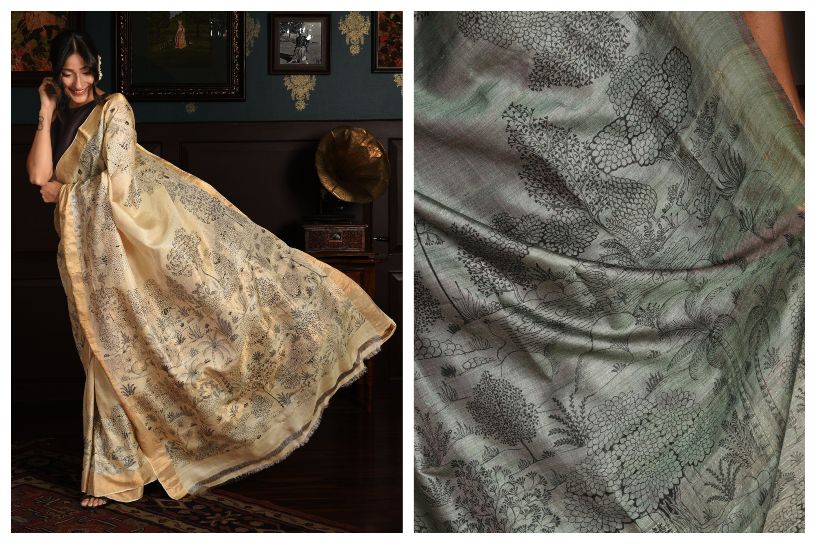
The collection is yet to drop online—following a showcase at Delhi Craft Council’s Sarees of India exhibition in September, its campaign is due for launch on social media ahead of Diwali. The Voice of Fashion gets a first look at the saris at Jain’s Delhi studio in late October. “I wanted to explore pattachitra for a long time but shied from the bright colours for saris,” says Jain, adding that she also wanted to explore a different line of thought from the folk art’s dominant narrative of the Raasleela. The inspiration came from a series of motifs that recurred like punctuations in pattachitra. “What caught my eye were the trees—it was almost a botanical study of the many trees one finds in Odisha.”
The result is a marvel: jungle scenes on saris, with traditional pattachitra translated in black line drawings and a colour palette that goes from creamy tussar to warm rose and cool purple. “Brainstorming with the artists, I was able to diversify from the classic miniature representations. We’ve tried to zoom into the motifs—so it’s a more contemporary take” says Jain. “It’s also more commercially viable as it is less time-consuming to complete.” The craft and technique mark a new chapter for Vriksh, but it remains rooted in Jain’s love for Odisha that endures close to two decades after she began working in the state.
Jain’s oeuvre is rooted in the textile traditions of Odisha, where she has worked for 15 years.
A Love Letter to Odisha
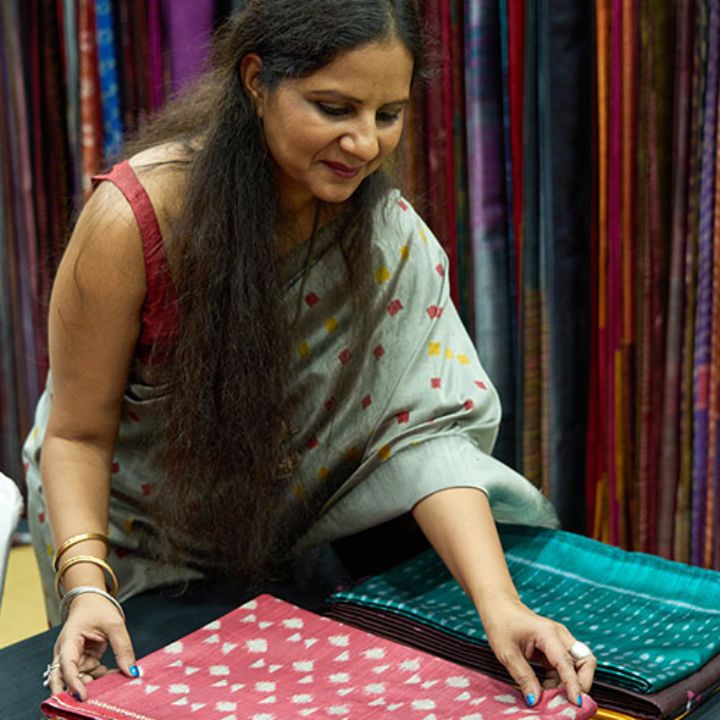
Since she launched the textile label Vriksh in 2008, designer Gunjan Jain has come to be known for her ability to bring together the textile traditions of Odisha with contemporary design ideas. At her studio, a space filled with archival textiles, craft souvenirs, art, books and greenery, a cupboard holds the label’s bestselling saris from various collections. Dressed in a handwoven silk kurta and an overlay made from a Vriksh ikat textile (more later), long hair framing her face, Jain is happiest when speaking of how each sari is made—in close collaboration with weavers who pride themselves for their narrative textiles.
Odisha is also second home for the designer who grew up in Delhi. Jain credits her mother, art historian Dr Pawan Jain, for inculcating an early interest in art and textiles. She would hear stories of her mother’s handlooms saris, and accompany her to museums. Following a design degree from Pearl Academy (Delhi) in the early 2000s, Jain worked with export houses and buyers before switching tracks four years later. Research drew her attention to Odisha. “The Sambalpuri ikat is well-known, but I found a gold mine once I went there,” she says. “Every district had unique handlooms, and there was a farm to fashion story, alive and serving the local population. I think of it as my ‘wild, wild east’ journey.”
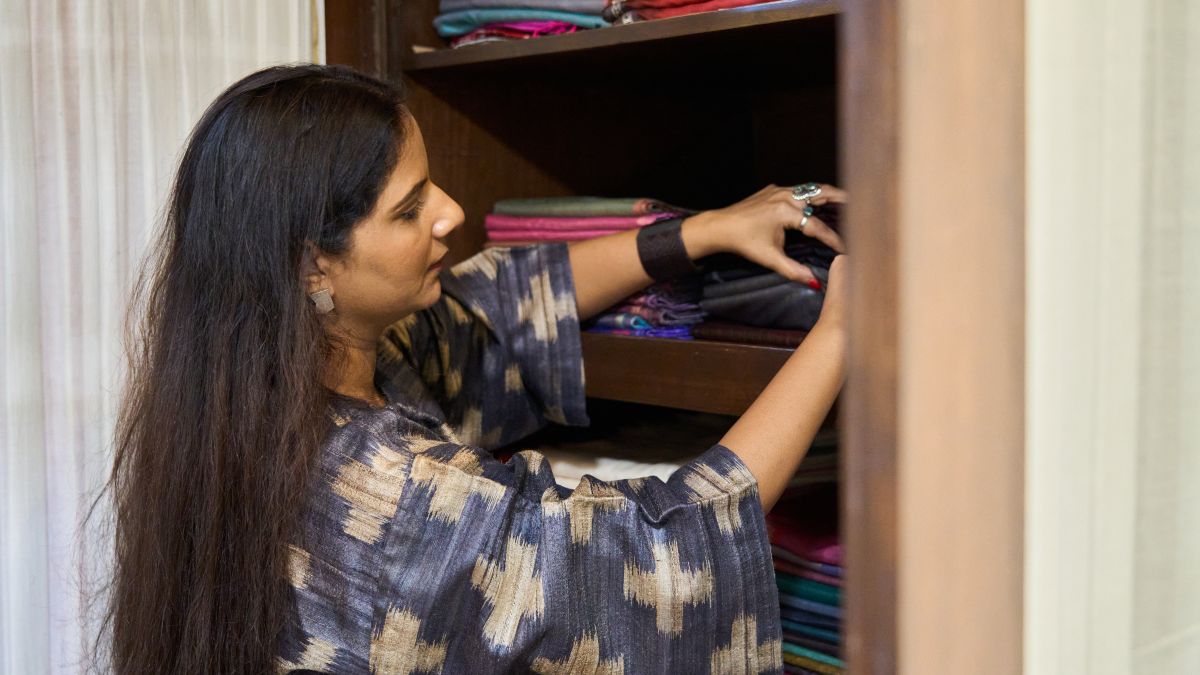
Jain calls Odisha a gold mine of textiles and artisanal skills.
The Sari Stories
Vriksh’s offerings include dupattas and stoles, but the six-yard sari is Jain’s primary medium of expression. New interventions abound in her collections—most visible in colour, motif and proportion. One of her early designs is the Jhoti sari inspired by the art made by the state’s women using rice paste. The highlight of tussar jaala garment is the multi-hued, glimmering sunshine-hued pallu. “I wanted to bring to the market pure tussar silk that has the shimmer of zari. The sari also exemplifies the fine technique of dyeing—the gradience is a demonstration of skill,” she says. That the sari continues to sell around a decade after it was first launched also makes a case for the transseasonal appeal of handloom design.
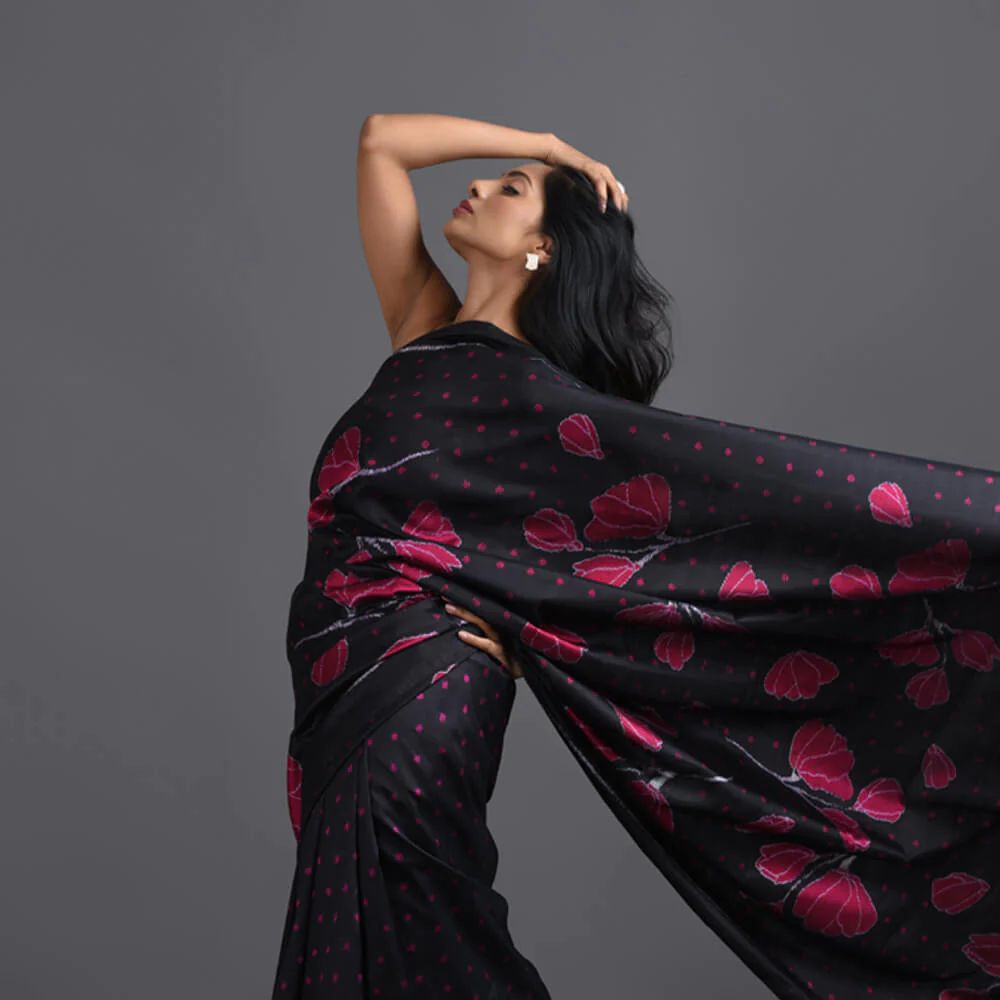
The Vriksh archive includes saris reviving the Ganjam bomkai, experiments with linen blends, to try and revive non-mercerised cotton; a ‘Masterpiece’ collection of saris revives natural dyeing in ikat—its highlight being the golden colour that is derived from jackfruit bark. Jain continues to dabble in various textile projects, but focuses primarily on ikat and extra weft jaala weaves. Some years ago, she worked with weavers to create what may be the first woven shibori saris on an Odisha jaala loom, drawing from American weaver-dyer Catherine Ellis’ technique. The ‘Bali Jatra’ collection launched in 2020, featured a conflation of South East Asian and Odisha motifs—to retell stories of the historical trade relations between these regions. In the recent ‘Gulaab’ saris, ikat roses float across the pallu—challenging to achieve on the loom, they make a case for the brand’s evolving design complexity.
Weaving the Future
Jain’s design interventions have taken her all around Odisha, and around 45 weaving families work with her. Much of this is concentrated in Nuapatna for ikats, and Gopalpur and Jajpur for tussar. Apart from that, she also engages artisans in the Ganjam district for bomkai and now, Puri for pattachitra among others. “When I go to a village, or collaborate with an artist or a weaver, I emphasise on innovation—I want Vriksh to be synonymous with that,” says Jain. “Weavers are masters of technique—so we try very consciously to innovate at that stage. That’s where the fire is.”
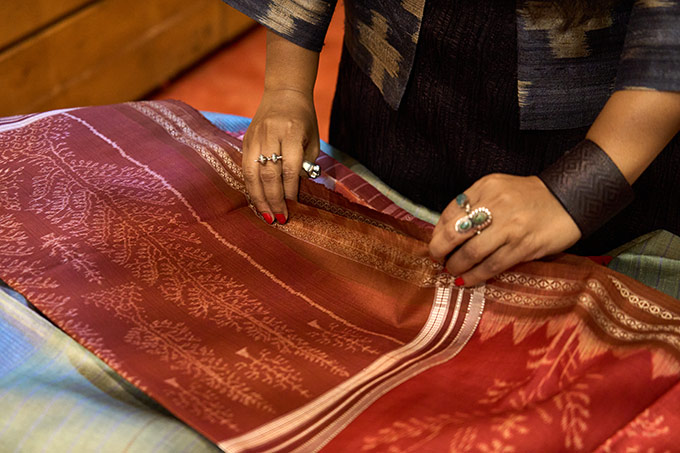
Enabling new ideas at the loom will enable weavers, who Jain sees as collaborators. “As a designer, rather than forcing my design ideas, can I build on their [knowledge],” she says. It can offer surprising results—as the brand’s popular ‘Badal’ sari testifies. It came about when a weaver wanted to try his hand at a cloudy pattern on the loom. The result is a multi-hued sari that resembles an Impressionist painting, and also revives a craft. “The Badal saris are ikat on tussar silk. It used to be practiced many years back, and we could bring it back because one weaver had a great idea. “
In another instance, a 65-year old weaver approached Jain. “His eyesight was failing and I wanted to work with him on a simple design,” she recalls, showing the saris he made. “He could weave and was a good dyer, so he worked together on colour chemistry. It’s the first time we have pastel shades,” she adds,
As a textile designer working in the crafts sector, Jain wears many hats. “I can’t just be a designer because the crafts sector comes with a lot of challenges and vulnerability,” she says. “We are competing with fast fashion and mass manufacturing; we have to be conscious of reverse migration and the fact that weavers need work.” It is what drove her to work on bomkai. Jain worked with Kabiraj, one of the only four weavers left in the village pursuing the craft; together, they reintroduced forgotten bomkai motifs and expanded the length of the sari to increase its marketability. Following Kabiraj’s death a few years ago, his wife continued the weaving and now has many customers.
The designer also engages in policy and advocacy for the artisanal sector—with twin focus on reverse migration and better wages. Design stories evoke joy, but Jain beams with pride when she says how her work in the state has convinced many weavers to return to the professions. “We also encourage our artisans to apply for national and state awards—and many of them have won.” Craft sustainability depends on community development—as she says, it takes a thriving village for textile traditions to continue.
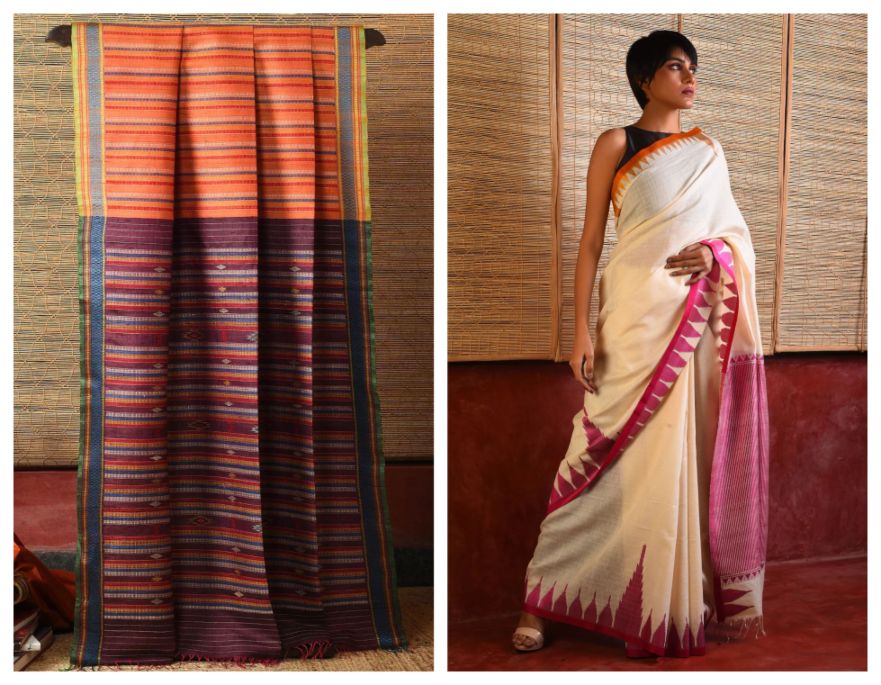
And for the brand’s urban community of fans and followers, Vriksh offers a new sartorial perspective of Odisha. Jain recalls how early consumer reactions to her work centred on how traditional the textiles were. “Today, we have an amalgamation of different looks— and I can see people reciprocating.” Having amassed a clientele for her saris, from Gen Zs to women in her 60s, Jain is now eyeing a new direction. “We may, very soon, enter the space of stitched garments,” she says, showing off her grey ikat jacket as an early prototype.
Banner: Gunjan Jain at her Delhi studio. Photograph: Rishabh Batra.
Zehn: Decolonising Indian Textiles is a series that celebrates designers, archivists, curators, weavers, scholars, institutions, revivalists and other artists who create modern, relevant connects with textile traditions.
Disclaimer: The article was modified to remove a mention of National Federation of Handloom and Handicrafts.